How Do You Tie a Sheet Bend Knot? (The Only Way You’ll Ever Need to Know)
Hey friend, welcome back to the woods.
You need to join two ropes together — especially when they are different thicknesses or materials — and you want the connection to hold strong. Then the sheet bend is the knot for you.
It is one of the best and most reliable knots for joining ropes of unequal sizes. Plus, it stays secure under load and still unties easily when the job is done.
In this guide I show you exactly how to tie a sheet bend. I keep the steps slow and clear. I also share the history behind it, the best uses, common mistakes, and real backwoods tips from years of use.
What Is a Sheet Bend knot Used For?
You can use it for many camp and survival tasks.
- Joining two ropes of different sizes or materials
- Extending a short rope with a longer one
- Repairing a broken guy line or ridge line
- Tying a tarp or shelter when you don’t have one long enough rope
- Any situation where you need to securely connect two separate pieces of rope
It holds extremely well even when the ropes are mismatched. So it works well whenever you need a strong, reliable connection in the field.
A Little History Behind the Sheet Bend
The sheet bend is another very old and important knot. Sailors have used it for centuries to join ropes of different thicknesses.
Its name comes from the “sheet,” the rope that controls the angle of a sail. When sailors needed to lengthen or repair a sheet, they reached for this bend.
Early references appear in sailing manuals from the 1600s, and it is clearly illustrated in many 19th-century knot books. Today it remains one of the six most important knots (alongside the bowline, clove hitch, and others) because it is simple, strong, and works with ropes of unequal size.
Citation: Sheet bend. (2026). In Wikipedia. Retrieved April 1, 2026, from https://en.wikipedia.org/wiki/Sheet_bend
Campers, sailors, and outdoorsmen have trusted this knot for hundreds of years. It gives a secure join even when the ropes look very different. So it remains one of the most practical knots for real-world use.
How to Tie a Sheet Bend – Step-by-Step
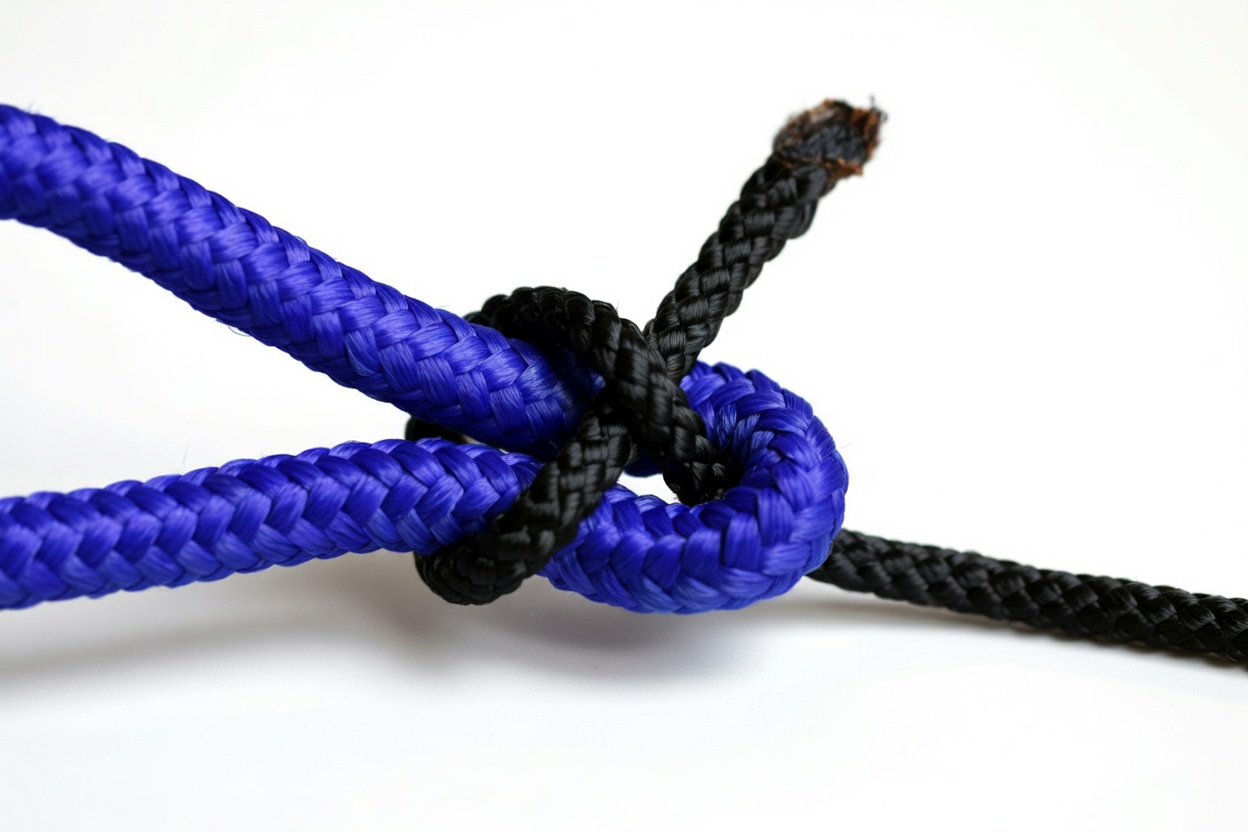
Setup Hold the thicker rope (or the rope you want to be the main line) with your left hand. Form a small loop in this rope so the working end is pointing upward. This loop is your “hole.”

Steps
1. Take the thinner rope (or the second rope) with your right hand. Push its working end up through the hole you made in the first rope from underneath. You should now feel the working end of the second rope poking out the top of the hole.

2. Take the working end of the thinner rope and wrap it behind the standing part of the thicker rope.

3. Bring it forward again so it goes completely around the thicker rope.

4. Now bring the working end of the thinner rope back through the loop you just made. You will feel the thinner rope naturally sliding alongside itself and forming a secure connection between the two ropes.

5. Pull steadily in opposite directions until the knot tightens and locks firmly in place. The two ropes should now feel solidly joined with no slippage when you tug on them.
Checkpoints
- Both ends of the thinner rope should be on the same side.
- The knot should feel tight and secure.
Lock It In Pull both standing parts away from each other until tight.
Common Mistakes & How to Fix Them
- Many people form the loop in the thinner rope instead of the thicker one. Then the knot will not hold properly.
- Others forget to bring the working end all the way around the standing part. So the connection slips under load.
- Finally, some pull unevenly or stop before the knot is fully tightened. In that case the bend stays loose. Always give both standing parts a firm, even pull to set it.
Backwoods Tip I end up using the sheet bend constantly when I need to extend a short rope or repair a broken line in the field. It doesn’t care if the two ropes are different sizes — it just holds, and it still unties easily when the job is done.

Want More Easy Knots?
You just learned knot #5 of my 8 Essential Survival Knots.
If you liked this guide, grab the free PDF with all eight knots right here:
Download Backwoods Bob’s 8 Essential Survival Knots PDF
Or check out the next post in the series when it goes live.
Stay safe out there, keep your rope handy, and I’ll see you in the next one.
— Backwoods Bob
gridfreelife.com