How Do You Tie a Two Half Hitches Knot? (The Only Way You’ll Ever Need to Know)
Hey friend, welcome back to the woods.
You need a quick, reliable way to attach a rope to a tree, post, ring, or any fixed object. Then the two half hitches knot is the one you want.
It is simple, fast to tie, and holds securely under steady tension. Plus, you can untie it with one hand when you are ready to move on.
In this guide I show you exactly how to tie a two half hitches knot. I keep the steps slow and clear. I also share the history behind it, the best uses, common mistakes, and real backwoods tips from years of use.
What Is a Two Half Hitches Knot Used For?
You can use it for many camp and survival tasks.
- Tying a rope securely to a tree or post
- Securing a ridgeline or tarp corner
- Attaching a bear bag or food bag to a branch
- Tying off a boat, canoe, or sled
- Any situation where you need a quick, strong attachment to a fixed point
It ties fast. It holds reliably under normal camp loads. So it works well whenever you need a solid connection without anything fancy.
A Little History Behind the Two Half Hitches Knot
The two half hitches knot is one of the oldest and simplest hitches in history. Sailors and fishermen have used versions of it for centuries to secure lines to posts, rings, and spars.
Early knot books from the 1600s already show similar hitches. By the 1800s it became a standard knot taught to sailors and Scouts because it is quick and dependable.
Today it remains a favorite in scouting manuals, boating guides, and outdoor survival resources. It is often called the “two half hitches” or simply “double half hitch.”
Citation: Two half-hitches. (2026). In Wikipedia. Retrieved April 1, 2026, from https://en.wikipedia.org/wiki/Two_half-hitches
Campers, sailors, and woodsmen have trusted this knot for hundreds of years. It gives a strong attachment with almost no effort. So it remains one of the most practical knots for everyday off-grid use.
How to Tie a Two Half Hitches Knot – Step-by-Step
Setup Hold the standing rope (the long fixed part) with your left hand. Take the working end (the free end) and wrap it once completely around the tree or post.
Steps:
1. Bring the working end up and over the standing rope so it crosses on top.

2. As you come around, pass the working end under the standing rope and then through the loop you just created. This forms the 1st half hitch.

3. Cross the working rope back over the standing rope.

4. As you come around, pass the working end under the standing rope and then through the loop you just created. This forms the second half hitch.

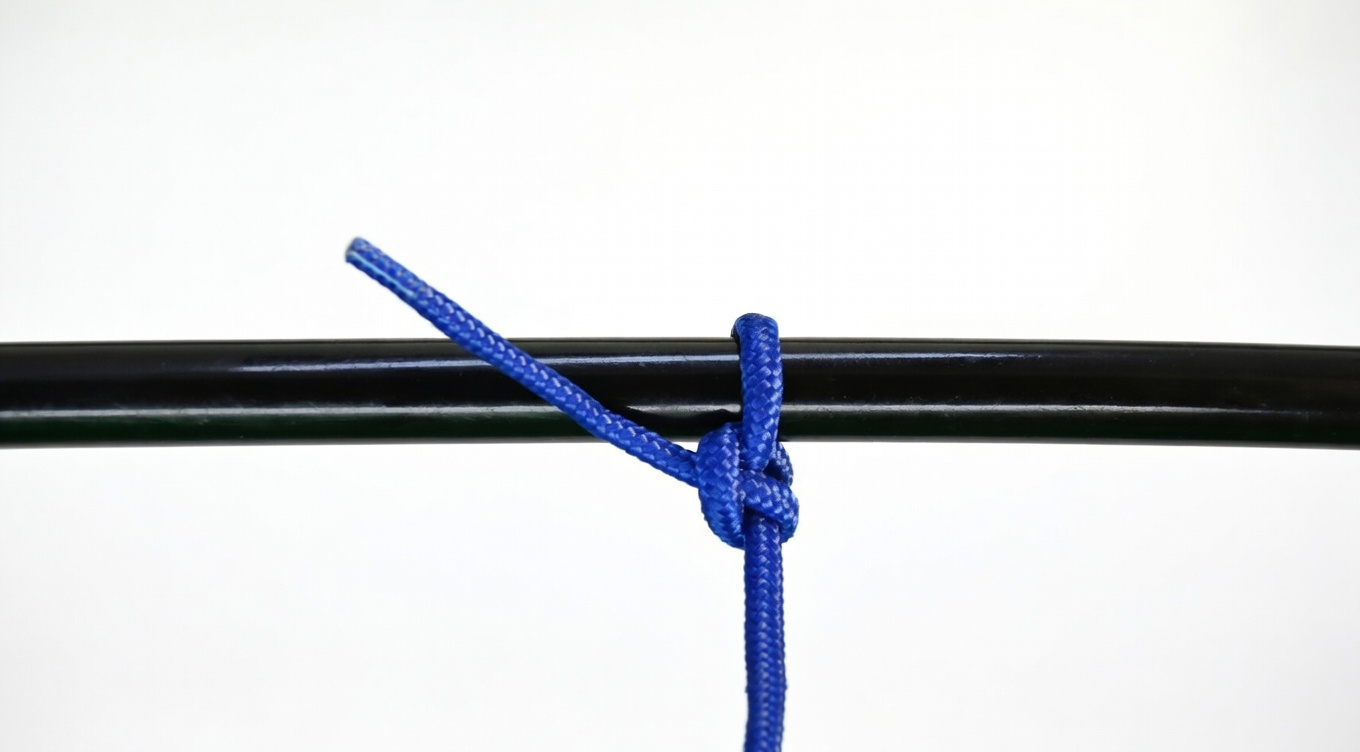
You should now have two identical half hitches sitting side-by-side on the standing rope, both wrapping in the same direction.
5. Pull steadily in opposite directions. You will feel both half hitches tighten and lock themselves snugly against the post or tree.

6. Tug on the standing rope to test the knot. It should feel solid and not slide along the post when tension is applied.
Checkpoints
- You should see two matching hitches in a row.
- Both should face the same direction.
Lock It In Pull the standing rope to tighten both hitches firmly.
Common Mistakes
- Many people wrap the second hitch in the opposite direction. Then the knot becomes a granny version and slips.
- Others stop after only one half hitch. So the connection is not strong enough.
- Finally, some pull the working end too tight before the hitches are side-by-side. In that case the knot looks messy and weak. Always make both hitches the same way and dress them neatly before you pull hard.
Backwoods Tip This is one of the fastest ways to tie something off and keep moving. I use the two half hitches knot almost every time I need to tie something quickly to a tree or post. It holds strong under normal camp loads. Plus, I can untie it with one hand when I am ready to move on. It is not flashy, but it rarely gives you a reason to second guess it.

Want More Easy Knots?
You just learned knot #6 of my 8 Essential Survival Knots.
If you liked this guide, grab the free PDF with all eight knots right here:
Download Backwoods Bob’s 8 Essential Survival Knots PDF
Or check out the next post in the series when it goes live.
Stay safe out there, keep your rope handy, and I’ll see you in the next one.
— Backwoods Bob
gridfreelife.com